Sales growth is a system. Traffic, conversion rate, average order value, repeat purchase rate, retention, margin, and operations all affect Shopify revenue.
Better traffic beats more traffic. Acquire shoppers with clearer intent, better audience fit, and landing pages that match the promise in the ad, search result, email, or social post.
Conversion still matters. Product pages, trust signals, mobile usability, clear policies, and checkout clarity help more existing visitors become customers.
AOV and merchandising create revenue without relying only on discounts. Bundles, thresholds, recommendations, filters, collection ordering, and product badges can make buying decisions easier.
Retention compounds the work. Post-purchase education, email flows, replenishment reminders, loyalty, support, and better customer experience help customers buy again.
Start with the Shopify sales equation
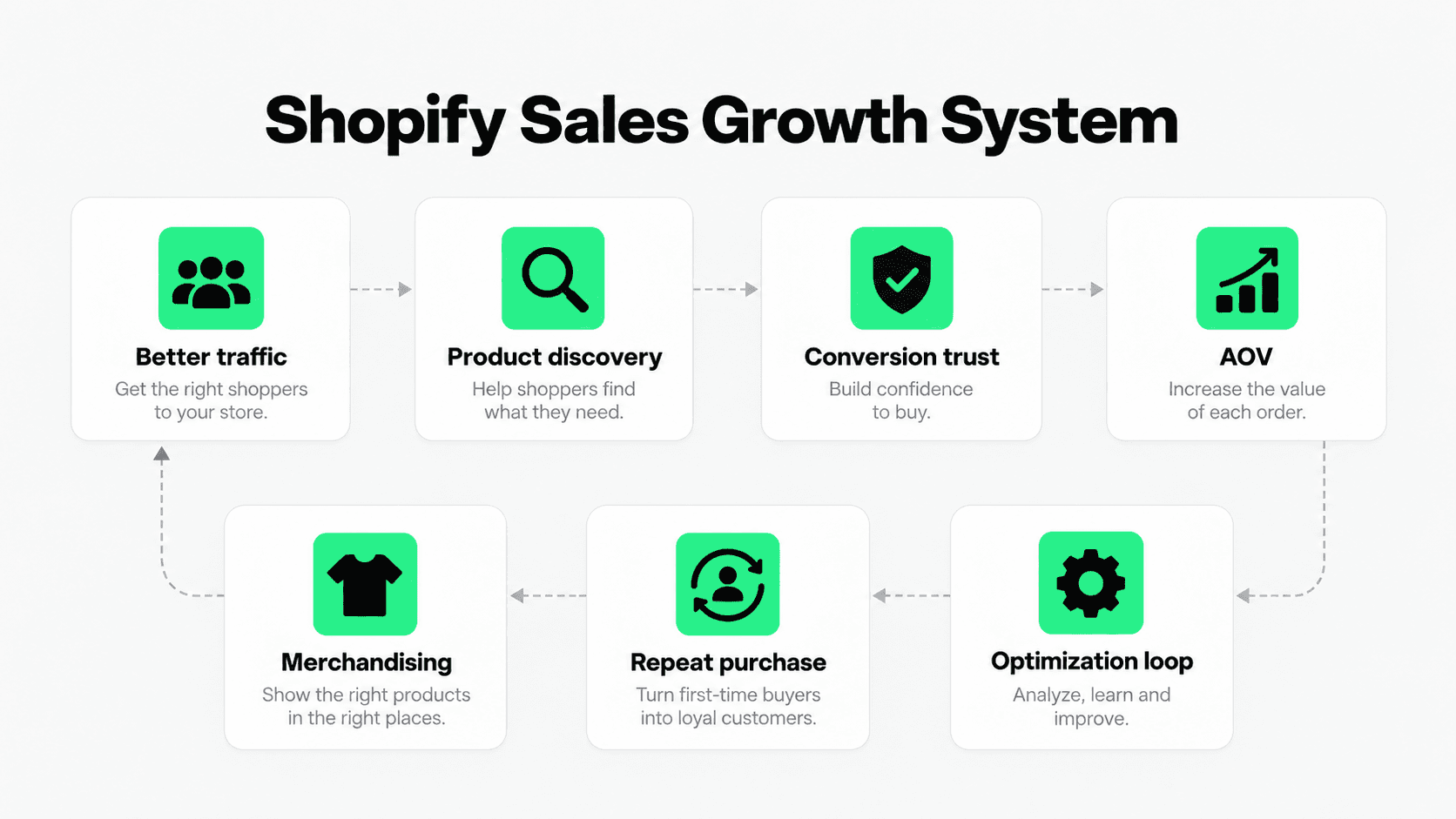
If you want to increase sales on Shopify, do not start with a random checklist of tactics. Start with the revenue equation: traffic quality, conversion rate, average order value, repeat purchase rate, retention, and margin. A store can grow by improving any of these levers, but the right order depends on where revenue is currently leaking.
Shopify’s 2026 ecommerce growth guide defines ecommerce growth as profitable revenue improvement through stronger conversion, higher repeat purchase rate, increased average order value, smarter expansion, and more efficient operations. That broader definition matters because it keeps merchants from treating conversion rate as the only sales lever. Source: Shopify ecommerce growth guide.
For a practical sales audit, separate the questions. Are the right people arriving? Are they reaching the right product? Do they understand the value? Do they trust the store? Is the offer strong enough? Is the cart clear? Do customers come back? Each answer points to a different improvement.
1. Acquire better-fit traffic, not just more traffic
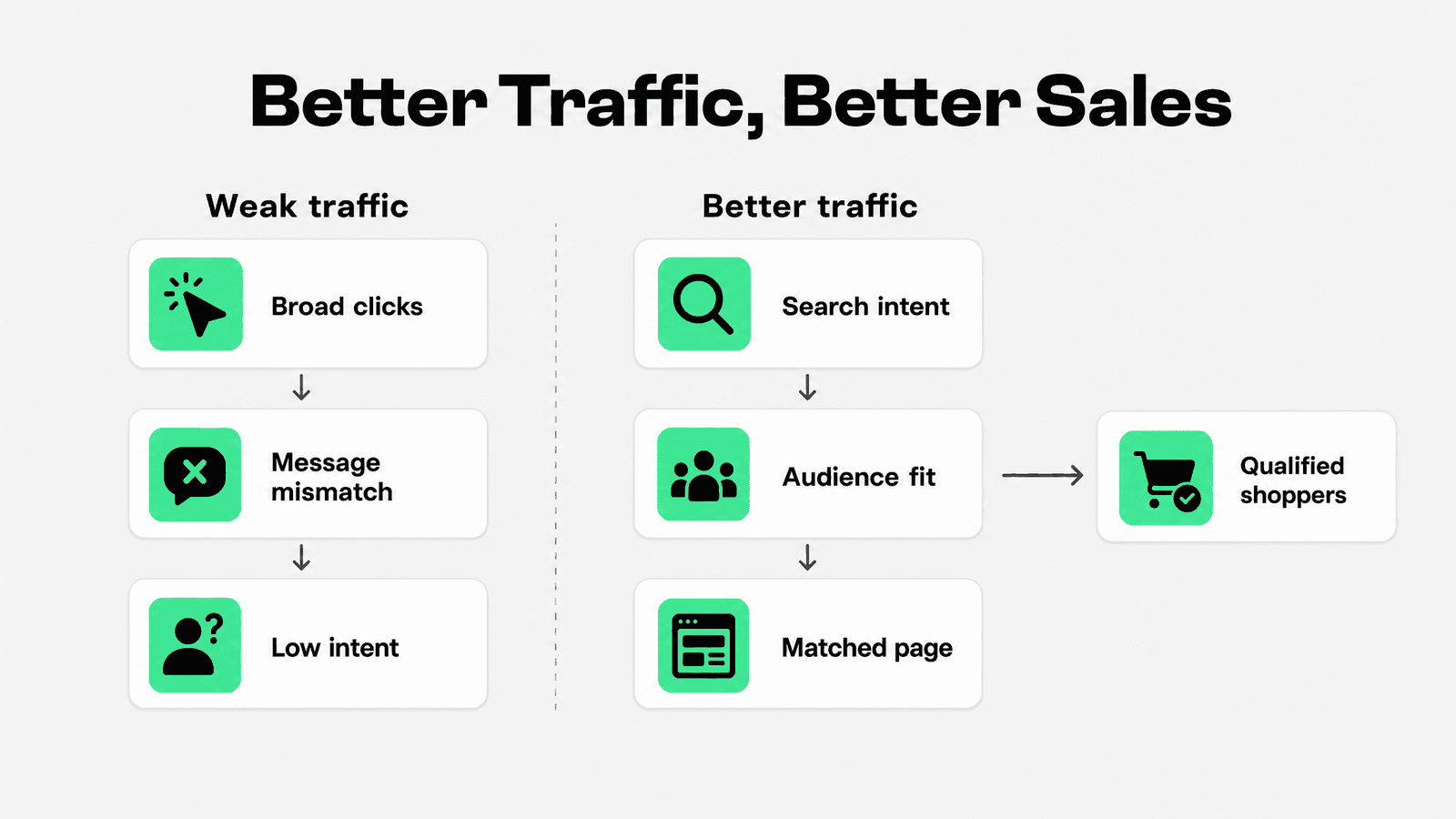
More traffic only helps when it brings people who are likely to want the product, trust the offer, and buy at the current price. If paid ads, influencer content, SEO pages, or social posts promise one thing and the landing page delivers something else, the store can get sessions without sales.
Start by comparing traffic sources against conversion rate, average order value, new customer revenue, returning customer behavior, and margin. Search traffic may convert better because intent is clearer. Social traffic may need stronger landing pages and proof. Email traffic may convert well but depend on list quality and offer timing.
Shopify’s customer acquisition guidance connects acquisition quality with LTV and AOV: higher average order value gives merchants more room to absorb acquisition costs. Use that logic when choosing channels, not just click price. Source: Shopify customer acquisition guide.
Match landing pages to intent. Send category searches to collections, product-specific searches to product pages, and educational queries to guides that naturally lead to products.
Tighten the promise. Ad copy, meta titles, creator scripts, and email subject lines should set expectations the page can immediately satisfy.
Prioritize qualified channels. A smaller source with stronger order quality can be more valuable than a high-volume source that creates low-intent sessions.
2. Improve product discovery so shoppers find the right item faster
A store can lose sales before shoppers ever reach a product page. Weak menus, vague collection names, poor filtering, inconsistent product cards, and confusing search results all make the catalog feel harder to shop.
For Shopify merchants, product discovery starts with navigation, collection structure, search, filters, product card clarity, and merchandising rules. Snapp’s guide to Shopify navigation and its guide to Shopify collection page best practices are useful internal reads because both focus on helping shoppers move from broad interest to the right product set.
Look for friction in the catalog. Are the main categories named the way customers think, or the way the team organizes inventory? Do collection pages explain who the products are for? Do filters match real buying criteria such as size, use case, material, compatibility, color, price, occasion, or delivery speed? Do product cards show enough information to compare without opening every item?
Better discovery is a revenue lever because it increases the number of shoppers who reach a product that fits their need. It also reduces pogo-sticking, support questions, and decision fatigue.
3. Make product pages convert by answering buying questions
A high-converting product page does not simply look polished. It answers the shopper’s real questions in the order they are likely to appear: What is this? Is it for me? Why this product? Which variant should I choose? What is included? When will it arrive? Can I return it? Can I trust this store?
Shopify’s conversion metrics guidance highlights average order value, conversion rate, and funnel behavior as useful ways to judge whether changes such as bundles, free shipping thresholds, or subscriptions improve sales outcomes. Source: Shopify conversion metrics guide.
For the product page itself, strengthen the above-the-fold area first. Product title, price, media, variant selector, review signal, delivery promise, return reassurance, and add-to-cart action should be clear on mobile. Then use the rest of the page to handle objections with benefit-led copy, specifications, use cases, comparison details, FAQs, reviews, and policy reminders.
Trust cues also belong close to decision moments. If payment options, returns, guarantees, shipping promises, or feature icons help reduce hesitation, place them near the buy area with a focused tool such as Snapp Trust Badges & Icons rather than hiding reassurance in a footer.
Cart and checkout clarity matter for the same reason. Baymard’s cart-abandonment research points to addressable friction such as unexpected costs, account friction, delivery uncertainty, form issues, and trust gaps. For Shopify stores, that means showing costs, delivery expectations, payment methods, and reassurance earlier instead of waiting until the final step. Source: Baymard cart-abandonment research.
4. Increase average order value with relevant offers
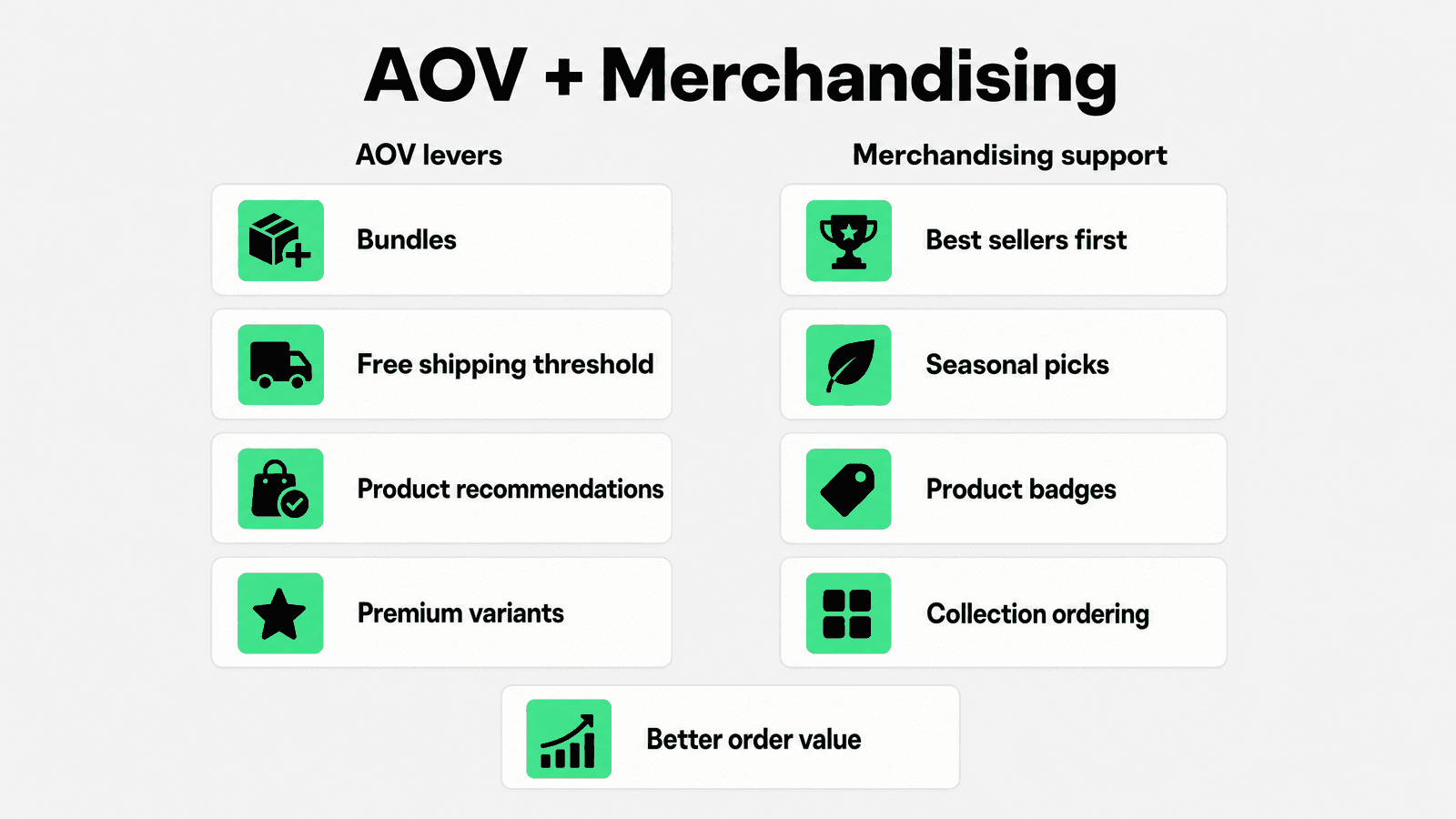
Average order value is one of the cleanest ways to boost sales on Shopify because it increases revenue from customers who are already ready to buy. The risk is that bad upsells can feel pushy, irrelevant, or distracting. AOV tactics should help shoppers build a better order, not interrupt the main purchase.
Use offers that make sense for the product and the customer’s intent. Bundles work when products naturally go together. Volume discounts work when customers genuinely need multiples. Free shipping thresholds work when the threshold is close enough to feel reachable. Cross-sells work when they solve the next problem, not when they are just excess inventory.
Promotional clarity matters here. A shopper should understand the offer before they reach checkout. Product pages, collection cards, cart drawers, and announcement bars can all support AOV when the message is specific: “Free shipping over $60,” “Buy 2 and save 15%,” “Complete the set,” or “Refill bundle saves 10%.”
5. Use merchandising to guide demand, not just display products
Merchandising is where sales strategy meets the shopping experience. It decides which products shoppers see first, how collections are grouped, which badges or labels draw attention, and how seasonal or margin priorities appear without making the store feel manipulated.
A good merchandising system helps shoppers compare, narrow, and decide. Use the Shopify merchandising guide as a companion piece for collection ordering, seasonal planning, product recommendations, and visual cues.
Start with your top collections. Put best sellers, new arrivals, high-margin items, seasonal picks, and clear problem-solution groupings where they are easy to find. Use product badges carefully: “Best seller,” “New,” “Low stock,” “Bundle,” “Free shipping,” or “Staff pick” can help when the label is true and the page is not covered in competing tags.
Merchandising can also reduce reliance on blanket discounts. Instead of discounting the entire store, highlight bundles, giftable items, starter sets, replenishment products, accessories, or premium variants that increase revenue while still helping the shopper.
6. Turn first-time buyers into repeat customers
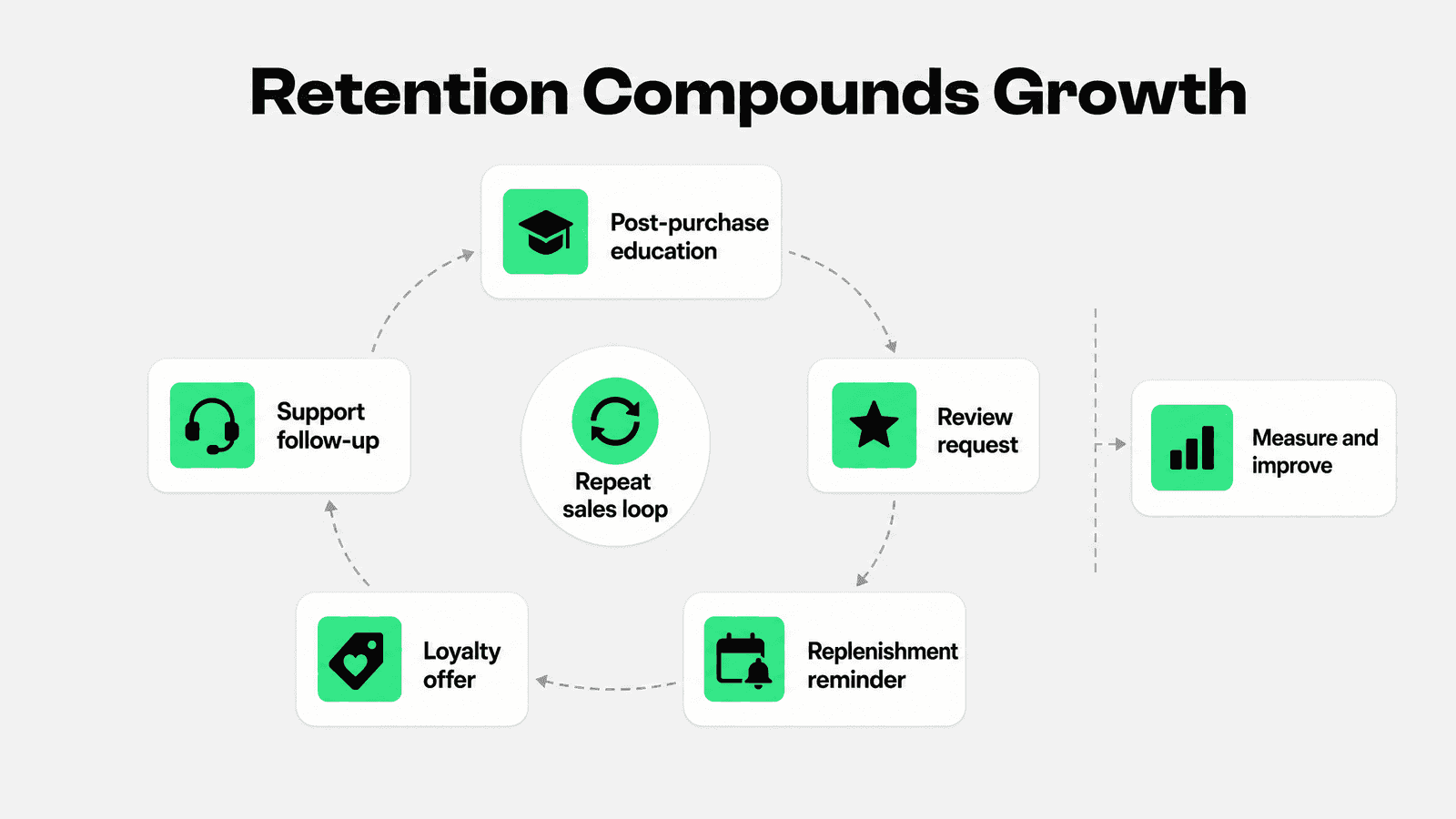
Many stores focus so heavily on the first purchase that they underbuild the second. Repeat purchases can be a major growth lever because the merchant has already paid to acquire the customer and already earned some trust.
Shopify’s KPI guidance recommends tracking repeat purchase rate, customer lifetime value, returning customer rate, and average order value alongside conversion metrics. Those numbers reveal whether sales growth is durable or only dependent on new traffic. Source: Shopify ecommerce KPI guide.
Build retention around the actual product cycle. Consumables may need replenishment reminders. Apparel may need styling ideas, size support, and seasonal launches. Home goods may need care instructions and complementary products. Gifts may need occasion reminders. Digital products may need onboarding and usage education.
The post-purchase experience should also reduce regret. Clear order updates, realistic shipping expectations, helpful product education, easy returns, and responsive support all increase the chance that the customer buys again and leaves a useful review.
7. Keep optimizing the full store, not one isolated page
Shopify sales growth is an ongoing optimization loop. A change that improves one metric can hurt another. A discount may raise conversion while shrinking margin. A popup may grow the email list while lowering mobile engagement. An upsell may lift AOV while reducing checkout completion. The store needs measurement discipline, not constant guesswork.
Shopify explains that online store web performance affects customer experience, discoverability, and conversion rates, and that added features can affect performance. That is why app, theme, image, and script decisions should be part of sales optimization. Source: Shopify web performance documentation.
Review the store on a recurring cadence. Check mobile usability, page speed, top landing pages, search terms, no-result searches, collection engagement, product-page add-to-cart rate, cart progression, checkout completion, average order value, repeat purchase behavior, support themes, and return reasons. Each cycle should produce a short list of specific improvements.
If you need lightweight tools to support trust, offer visibility, and key buying moments, use Shopify apps to increase sales that solve a clear problem without adding unnecessary clutter. The best app stack is the one shoppers barely notice because it makes the decision easier.
A 30-day plan to increase Shopify sales
Use this plan to turn the seven strategies into a focused month of store improvements.
Week | Focus | Actions | Metrics to watch |
|---|---|---|---|
Week 1 | Revenue and funnel audit | Review traffic sources, conversion by device, top landing pages, product-page behavior, add-to-cart rate, checkout completion, AOV, repeat purchase rate, and return reasons. | Sessions, conversion rate, add-to-cart rate, reached checkout, completed checkout, AOV, returning customer rate. |
Week 2 | Traffic and discovery | Tighten ad/search/message match, improve key collection pages, update menus, refine filters, strengthen product cards, and fix no-result searches. | Landing-page engagement, product views per session, collection click-through, search conversion, channel conversion. |
Week 3 | Conversion and trust | Improve top product pages, clarify shipping and returns, add accurate payment/trust cues, strengthen reviews or proof, and test mobile buying paths. | Product conversion, add-to-cart rate, cart creation, support questions, mobile conversion. |
Week 4 | AOV and retention | Add relevant bundles, thresholds, recommendations, post-purchase education, replenishment flows, review requests, and customer-segment follow-ups. | AOV, units per order, repeat purchase rate, email revenue, customer lifetime value, margin. |
Conclusion
The best answer to how to increase Shopify sales is not one hack. It is a practical system: bring in better-fit traffic, help shoppers find the right products, make product pages clearer, reduce trust and checkout friction, raise average order value with relevant offers, merchandise intentionally, and keep customers coming back.
Start with the biggest leak, fix it, measure the closest metric, and repeat. That approach is slower than chasing every tactic, but it builds a store that can grow with cleaner data, better customer experience, and more durable revenue.