TL;DR
A good Shopify returns policy answers four questions fast: how long shoppers have, what condition items must be in, who pays return shipping, and when refunds or exchanges happen.
The best return policy for Shopify store pages is specific, not legalistic. Use plain language, real dates or windows, and clear exclusions instead of vague “case by case” promises.
Return policy examples should match the product risk. Apparel needs size exchanges, beauty needs hygiene rules, subscriptions need cancellation clarity, and custom products need final-sale language.
Placement matters. Show the short return promise near product decisions and cart reassurance, then link to the full Shopify returns policy.
Snapp can make the promise visible. Merchants can use clean return badges, product benefit icons, and policy reassurance blocks without turning the page into a wall of badges.
Why Shopify return policy examples matter
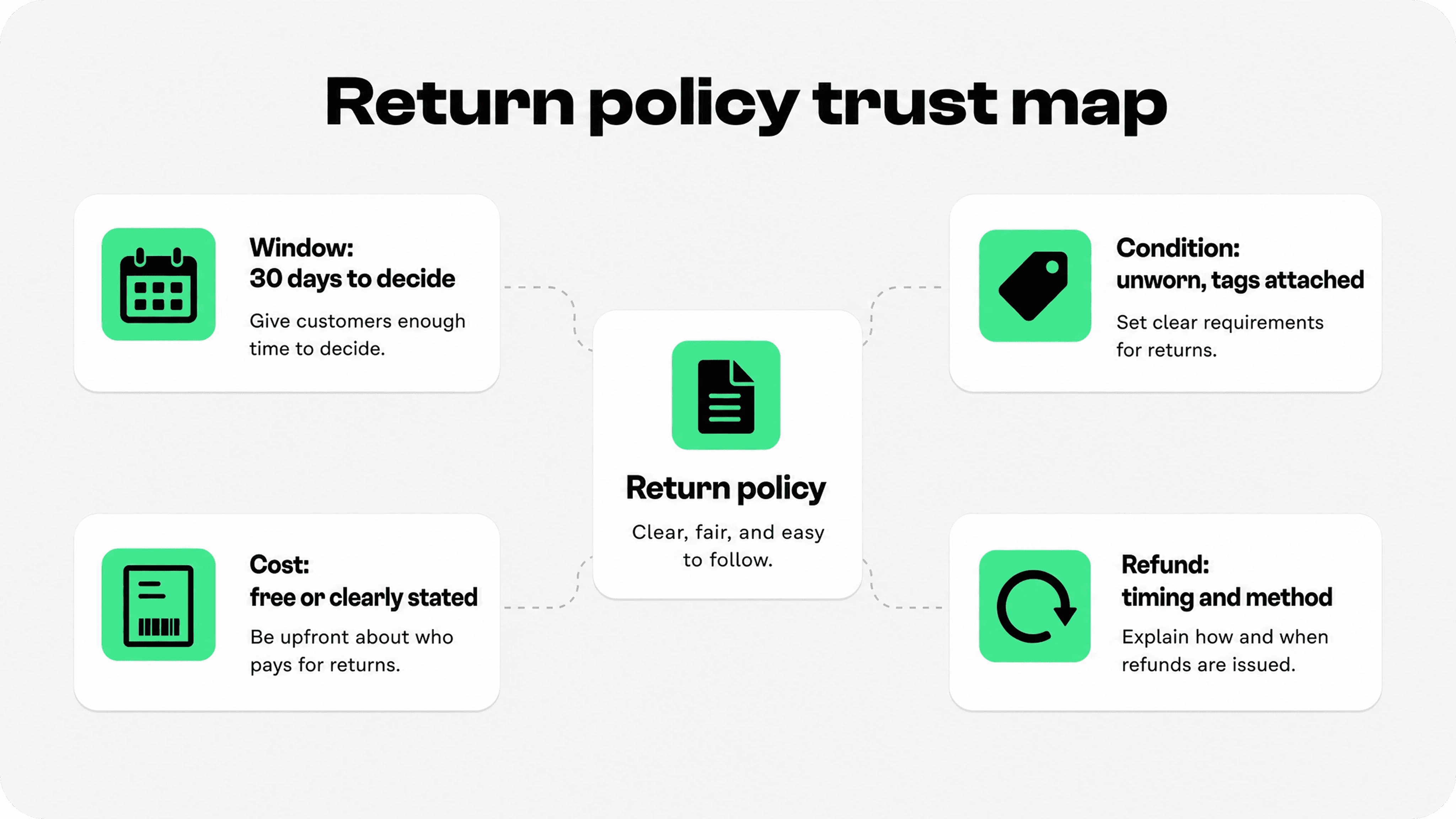
A return policy is not just a support document. For a first-time shopper, it is part of the buying decision. If they are unsure about fit, quality, sizing, color, delivery timing, or whether a gift will be right, the return policy becomes a trust signal.
That is why Shopify return policy examples should be treated as conversion copy as much as operations copy. The policy needs to protect the merchant, but it also needs to make the shopper feel that the post-purchase experience is predictable.
Shopify gives merchants a return and refund policy area in Settings > Policies, plus an English template option for compatible checkouts, but Shopify also makes the merchant responsible for reviewing and following the policy they publish. Source: Shopify Help Center.
Shopify also supports self-serve return and cancellation requests when merchants activate the feature and use the newer customer accounts experience. Source: Shopify self-serve returns documentation.
The practical takeaway: do not copy a template blindly. Use examples to decide what your store should promise, then write the policy around the real workflow your team can fulfill.
What a trustworthy Shopify returns policy should include
Every return policy for Shopify store use should answer the same core questions. Shoppers should not have to open support chat just to understand whether an item qualifies.
Return window: the number of days after delivery or purchase when a return can be started.
Eligible items: which products can be returned, exchanged, refunded, or replaced.
Item condition: unworn, unused, sealed, tags attached, original packaging, or product-specific requirements.
Return method: self-serve portal, email support, in-store return, carrier label, or manual approval.
Return shipping: whether the store provides a prepaid label, deducts a fee, requires customer-paid postage, or covers only exchanges.
Refund method: original payment method, store credit, exchange, warranty replacement, or gift-card credit.
Refund timing: when the refund is processed after the item is received and how long banks or providers may take to post it.
Exceptions: final sale, personalized items, hygiene products, gift cards, damaged items, international orders, or holiday extensions.
The trust-building version of this list is short, scannable, and written in the order shoppers care about: Can I return it? How long do I have? What will it cost? How do I start?
Shopify return policy examples you can adapt
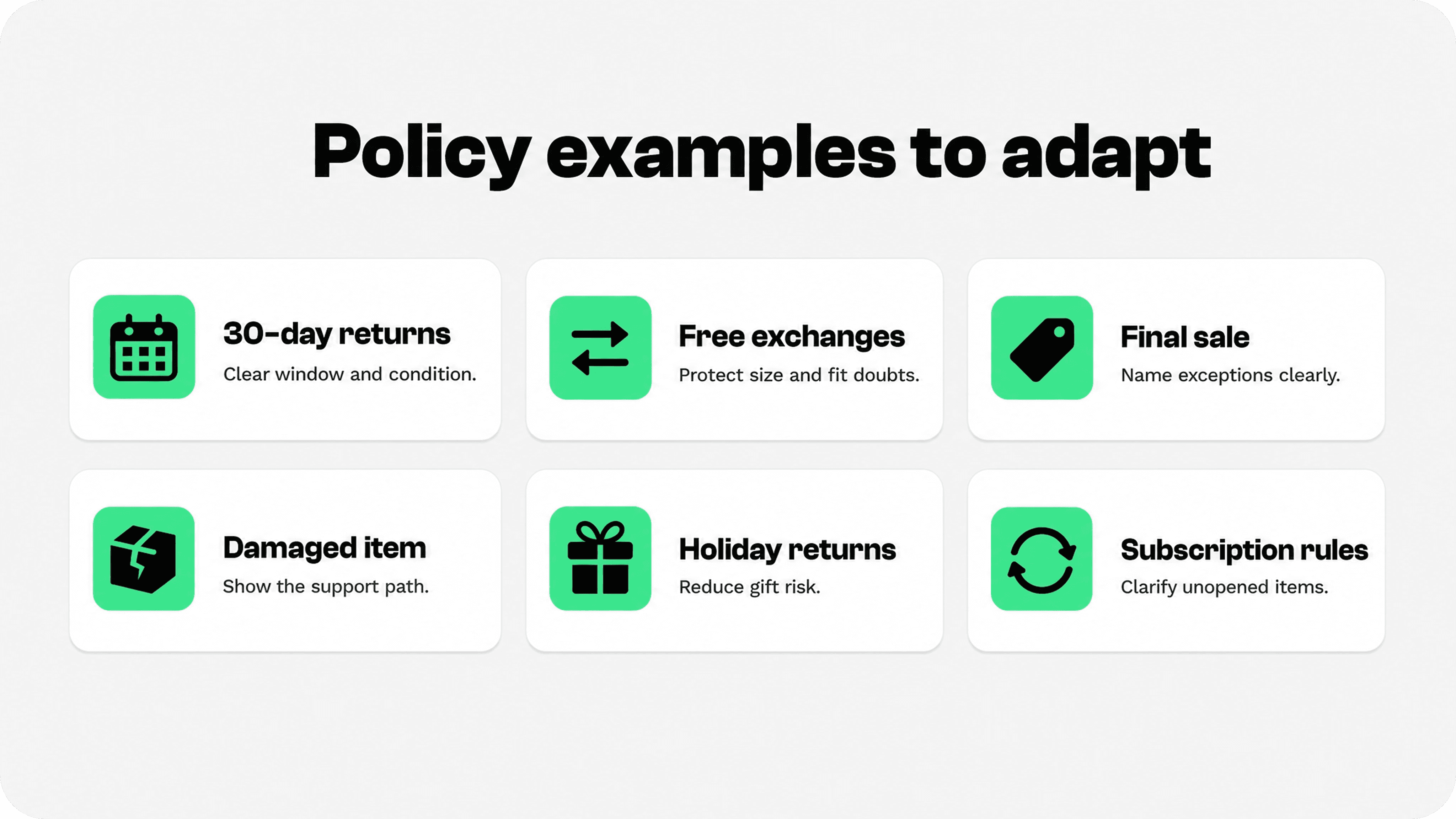
Use these ecommerce return policy examples as starting points, not as legal advice. The right return policy example depends on product type, margins, fraud risk, shipping cost, local law, and customer expectations.
Policy type | Best for | Example wording | Trust note |
|---|---|---|---|
Standard 30-day returns | Most physical products with manageable return costs | You can return eligible items within 30 days of delivery. Items must be unused, in original condition, and returned with tags or packaging. | Works because it answers timing and condition in one sentence. |
Free exchanges, paid returns | Apparel, footwear, accessories, and size-sensitive products | Exchanges for a different size or color are free within 30 days. If you prefer a refund, the return label cost may be deducted from your refund. | Encourages revenue-saving exchanges while staying clear about refund cost. |
Final sale with clear exceptions | Clearance, personalized, hygiene, digital, or made-to-order items | Final sale items cannot be returned or exchanged unless they arrive damaged, defective, or incorrect. | Reduces disputes by naming the exception shoppers expect. |
Damaged or wrong item replacement | Stores with fragile, customized, or multi-SKU fulfillment | If your order arrives damaged, defective, or incorrect, contact us within 7 days with your order number and photos so we can make it right. | Sets a fast reporting window and tells shoppers what proof is needed. |
Holiday return extension | Gift-heavy categories and seasonal campaigns | Orders delivered between November 1 and December 24 can be returned or exchanged until January 15, as long as the item meets our return conditions. | Makes gift buying feel less risky during peak season. |
Subscription or consumable policy | Beauty, supplements, food, subscriptions, replenishment products | Unopened items can be returned within 30 days. Opened consumables are not returnable, but contact us if something arrives damaged or incorrect. | Balances safety and hygiene rules with a support path. |
The strongest return policy example is usually the one that uses plain constraints. “30-day returns on unused items” is clearer than “returns accepted at our sole discretion.”
Real ecommerce return policy examples to learn from
Large ecommerce brands show how different return policies can still feel trustworthy when the rules are easy to find and specific.
Allbirds keeps its promise simple: returns are covered by the brand within 30 days, with product-specific rules such as intact labels for apparel and unopened packaging for socks and underwear. Source: Allbirds return policy.
Gymshark uses a standard 30-day unwanted-product return window and clearly lists exceptions such as underwear, swimwear, socks, and bottles for hygiene reasons. Source: Gymshark returns policy.
Patagonia’s return experience is built around its broader guarantee and repair culture, with the main returns page connecting returns, repairs, trade-ins, and product care. Source: Patagonia returns page.
Bombas goes further with a Happiness Guarantee that includes 30-day refunds, a longer holiday period for November and December purchases, and post-refund options such as exchanges, replacements, or store credit. Source: Bombas About page.
Small Shopify merchants do not need to copy these policies exactly. The lesson is that trust comes from matching the policy to the brand promise. A premium apparel store might emphasize fit exchanges. A sustainable outdoor brand might connect returns to repairs. A consumable brand might emphasize damaged or incorrect order support while keeping opened items non-returnable.
Where to display your return policy for Shopify store trust

A return policy only builds trust if shoppers see it before they need it. Footer-only policy links are useful for completeness, but they are not enough for products where sizing, fit, gifting, fragility, or price creates risk.
Product page: show a short line such as “30-day returns” or “Free size exchanges” near the buy area, then link to the full policy.
Cart page or cart drawer: repeat the short reassurance near the checkout button when return risk is a common reason to hesitate.
Policy page: publish the full Shopify returns policy with headings, steps, eligibility rules, exceptions, and contact instructions.
FAQ or help center: turn the most common return questions into short support answers.
Order confirmation and delivery emails: remind customers how to start a return or exchange after purchase.
Product badges and icon blocks: use a clear return badge only when the promise is real and backed by the policy.
Baymard’s returns UX research points to a common missed opportunity: return options should be easy to discover, and in-store returns should be presented alongside mail options when available. Source: Baymard returns UX research.
For Shopify stores, that means the policy page should not be the only place the return promise appears. Put the summary near the decision, then keep the full policy one click away.
How to write return policy copy that feels honest
The tone of a Shopify returns policy matters. A policy can be firm without sounding hostile. The best version explains the rule, why it exists when useful, and what the customer should do next.
Use “within 30 days of delivery” instead of “within a reasonable period.”
Use “unworn, unwashed, and with tags attached” instead of “in sellable condition” when selling apparel.
Use “the return label cost will be deducted from your refund” instead of “customer is responsible for all return costs” when using prepaid labels.
Use “final sale unless damaged, defective, or incorrect” instead of “no exceptions” for clearance or custom items.
Use “refunds are processed within 5 business days after we receive your return” instead of “refunds are processed as soon as possible.”
For U.S. merchants, refund and cancellation wording also needs to stay consistent with applicable rules around shipping promises and delayed orders. The FTC’s Mail, Internet, or Telephone Order Merchandise Rule requires sellers to have a reasonable basis for advertised shipping times and to seek consent or provide refunds when shipping is delayed beyond the promised time or, if no time is stated, 30 days. Source: FTC rule page.
This is one reason a return policy should not promise more than the operation can handle. If the store says returns are easy, the labels, support response, warehouse receiving, and refund workflow need to support that promise.
How Snapp fits into return policy trust
Snapp is useful when a Shopify merchant wants the short return promise to be visible without hard-coding badge strips or rebuilding product templates. Return policy copy still belongs in the policy page, but the reassurance cue belongs near the buying decision.
With Snapp Trust Badges & Icons, merchants can add clean return badges, product benefit icons, payment icons, shipping cues, and reassurance banners that match the store design.
This supports Snapp’s broader positioning for merchants comparing Shopify apps to increase sales, because return reassurance can sit beside payment, shipping, guarantee, and product-benefit signals.
For related placement strategy, link readers to Snapp’s guide on Shopify trust badges and the guide to product feature icons for Shopify product pages.
Return policy quality check before publishing
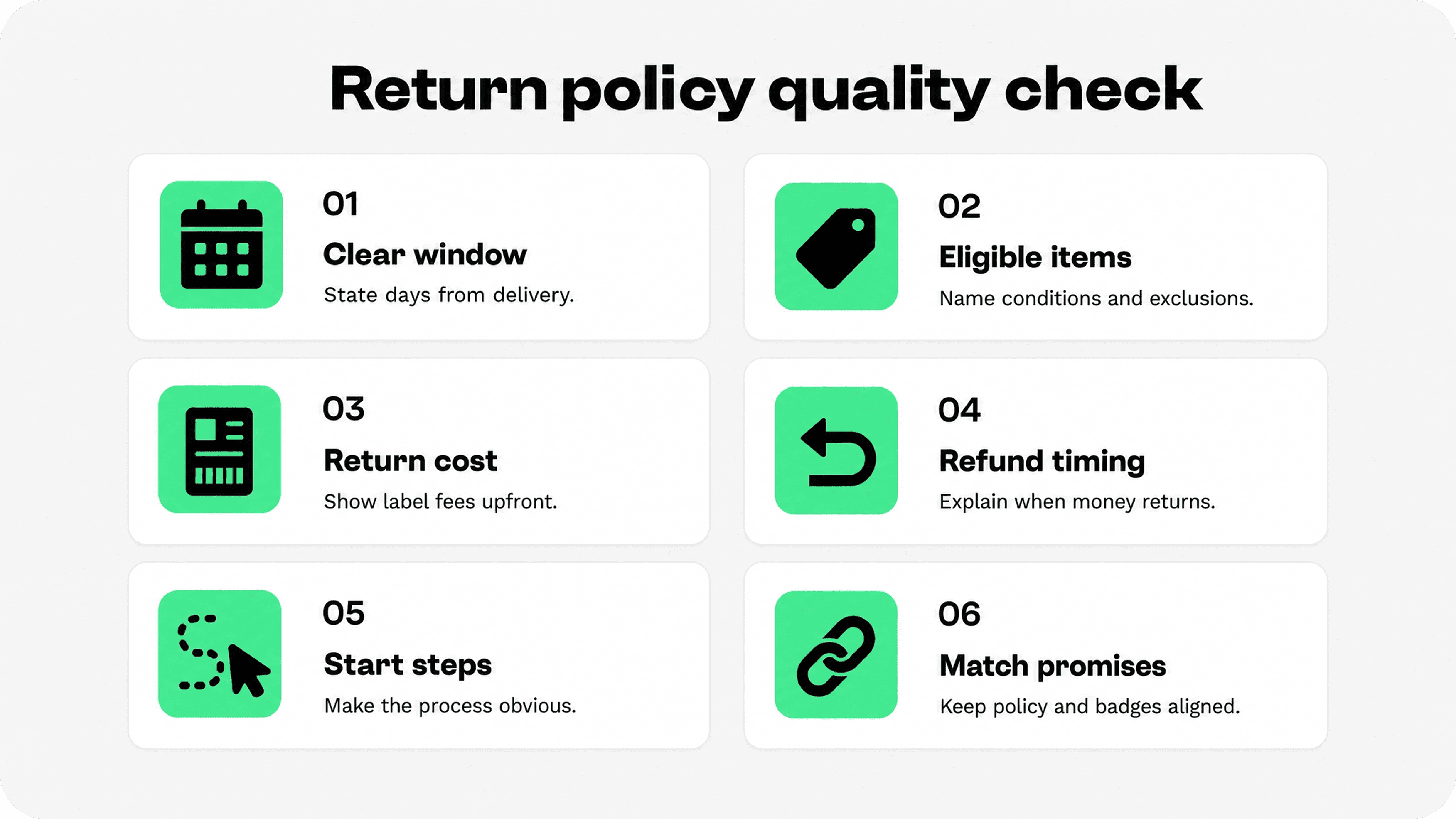
Before publishing a Shopify returns policy, run it through a short quality check.
Can a shopper understand the return window in under five seconds?
Does the policy explain who pays return shipping and whether any fees are deducted?
Are exclusions clear enough for support agents and customers to interpret the same way?
Does the short product-page promise match the full policy exactly?
Does the policy explain how to start a return, not just whether returns are accepted?
Is the mobile version easy to scan with headings, bullets, and links?
Can the operations team actually meet the refund timing and exchange promise?
If the answer is no, fix the policy before adding more return badges. A badge can make a strong policy more visible, but it cannot make a vague policy trustworthy.
Final recommendation
The best Shopify return policy examples are not the longest or most generous. They are the clearest. A trustworthy policy tells shoppers what qualifies, how long they have, what it costs, how refunds work, and what to do next.
Start with the operational truth, write it in plain language, show the short promise near product and cart decisions, and keep the full Shopify returns policy easy to find. That combination builds more trust than a generic template hidden in the footer.